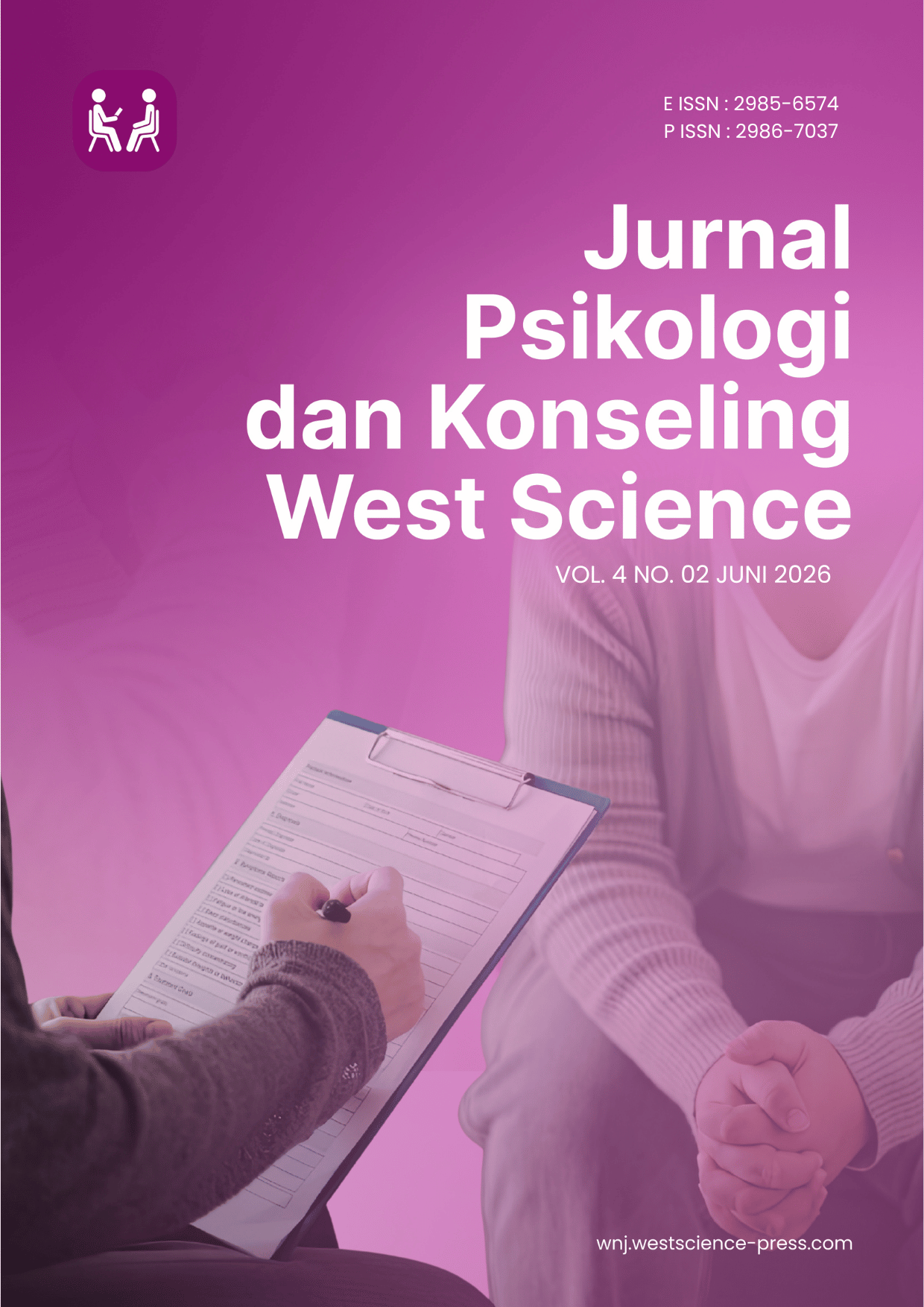
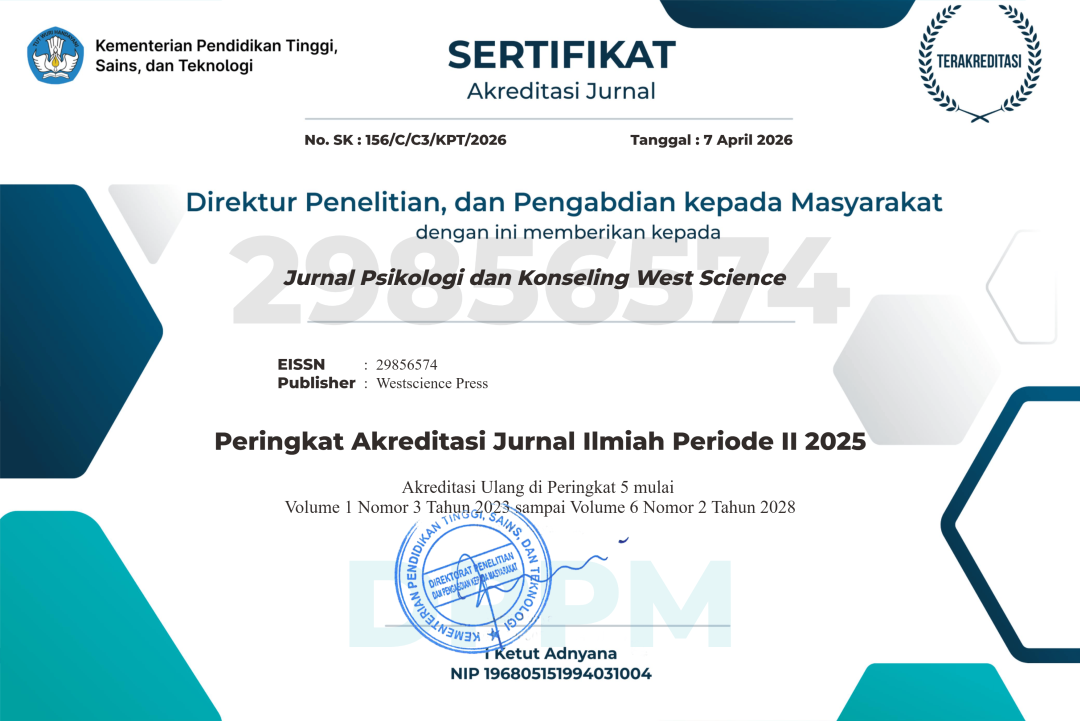
Silent Users di Ruang Digital: Pengaruh Social Media Fatigue terhadap Perilaku Lurking pada Remaja Akhir
DOI:
https://doi.org/10.58812/jpkws.v4i02.3620Kata Kunci:
Social Media Fatigue, Perilaku Lurking, Remaja Akhir, Pengguna Media Sosial, Ruang DigitalAbstrak
Media sosial telah menjadi bagian penting dalam kehidupan remaja akhir, tetapi intensitas penggunaan yang tinggi dapat memunculkan social media fatigue yang berdampak pada perubahan pola partisipasi pengguna di ruang digital. Salah satu bentuk perubahan tersebut adalah perilaku lurking, yaitu kecenderungan pengguna untuk mengamati aktivitas di media sosial tanpa berpartisipasi secara aktif. Penelitian ini bertujuan untuk menguji pengaruh social media fatigue terhadap perilaku lurking pada remaja akhir pengguna media sosial.Penelitian menggunakan pendekatan kuantitatif dengan metode survei terhadap 272 remaja akhir berusia 18–21 tahun yang aktif menggunakan media sosial dalam enam bulan terakhir. Data dikumpulkan menggunakan Social Media Fatigue Scale dan skala lurking behavior, kemudian dianalisis menggunakan regresi linear sederhana dengan bantuan IBM SPSS Statistics 23. Hasil analisis menunjukkan bahwa social media fatigue berpengaruh positif dan signifikan terhadap perilaku lurking (β = 0,719; p < 0,001) dengan kontribusi sebesar 51,7%. Semakin tinggi social media fatigue yang dialami remaja akhir, semakin tinggi kecenderungan mereka untuk melakukan perilaku lurking. Temuan ini menunjukkan bahwa kelelahan media sosial berperan penting dalam membentuk pola partisipasi pengguna dan perlu diperhatikan dalam upaya menciptakan pengalaman bermedia sosial yang lebih sehat.
Referensi
Amichai-Hamburger, Y., Gazit, T., Bar-Ilan, J., Perez, O., Aharony, N., Bronstein, J., & Dyne, T. S. (2016). Psychological factors behind the lack of participation in online discussions. Computers in Human Behavior, 55, 268–277. https://doi.org/10.1016/j.chb.2015.09.009
Azwar, S. (2019). Reliabilitas dan validitas (4th ed.). Pustaka Pelajar.
Boyd, D. M., & Ellison, N. B. (2007). Social network sites: Definition, history, and scholarship. Journal of Computer-Mediated Communication, 13(1), 210–230. https://doi.org/10.1111/j.1083-6101.2007.00393.x
Bright, L. F., Kleiser, S. B., & Grau, S. L. (2015). Too much Facebook? An exploratory examination of social media fatigue. Computers in Human Behavior, 44, 148–155. https://doi.org/10.1016/j.chb.2014.11.048
Cao, X., & Sun, J. (2018). Exploring the effect of overload on the discontinuous intention of social media users: An S-O-R perspective. Computers in Human Behavior, 81, 10–18. https://doi.org/10.1016/j.chb.2017.11.035
DataReportal. (2025). Digital 2025: Global overview report. https://datareportal.com/reports/digital-2025-global-overview-report
Dhir, A., Yossatorn, Y., Kaur, P., & Chen, S. (2018). Online social media fatigue and psychological wellbeing: A study of compulsive use, fear of missing out, fatigue, anxiety and depression. International Journal of Information Management, 40, 141–152. https://doi.org/10.1016/j.ijinfomgt.2018.01.012
Do you get tired of socializing? An empirical explanation of discontinuous usage behaviour in social network services. Information & Management, 58(2), 103314. https://doi.org/10.1016/j.im.2020.103314
Field, A. (2018). Discovering statistics using IBM SPSS statistics (5th ed.). Sage Publications.
Hair, J. F., Black, W. C., Babin, B. J., & Anderson, R. E. (2019). Multivariate data analysis (8th ed.). Cengage Learning.
Kaplan, A. M., & Haenlein, M. (2010). Users of the world, unite! The challenges and opportunities of social media. Business Horizons, 53(1), 59–68. https://doi.org/10.1016/j.bushor.2009.09.003
Katz, E., Blumler, J. G., & Gurevitch, M. (1973). Uses and gratifications research. Public Opinion Quarterly, 37(4), 509–523. https://doi.org/10.1086/268109
Kircaburun, K., Alhabash, S., Tosuntaş, Ş. B., & Griffiths, M. D. (2020). Uses and gratifications of problematic social media use among university students: A simultaneous examination of the Big Five personality traits, social media platforms, and social media use motives. International Journal of Mental Health and Addiction, 18(3), 525–547. https://doi.org/10.1007/s11469-018-9940-6
Malik, A., Dhir, A., & Nieminen, M. (2020). Uses and gratifications of digital photo sharing on Facebook. Telematics and Informatics, 33(1), 129–138.
Nguyen, T.-M. (2021). Four-dimensional model: A literature review on reasons behind lurking behavior. VINE Journal of Information and Knowledge Management Systems, 51(3), 411–426. https://doi.org/10.1108/VJIKMS-10-2019-0168
Nonnecke, B., & Preece, J. (2001). Why lurkers lurk. In AMCIS 2001 Proceedings (pp. 1523–1530).
Nunnally, J. C., & Bernstein, I. H. (1994). Psychometric theory (3rd ed.). McGraw-Hill.
Przybylski, A. K., Murayama, K., DeHaan, C. R., & Gladwell, V. (2013). Motivational, emotional, and behavioral correlates of fear of missing out. Computers in Human Behavior, 29(4), 1841–1848. https://doi.org/10.1016/j.chb.2013.02.014
Ravindran, T., Yeow Kuan, A. C., & Hoe Lian, D. G. (2014). Antecedents and effects of social network fatigue. Journal of the Association for Information Science and Technology, 65(11), 2306–2320.
Sun, N., Rau, P. P., & Ma, L. (2014). Understanding lurkers in online communities: A literature review. Computers in Human Behavior, 38, 110–117. https://doi.org/10.1016/j.chb.2014.05.022
Valkenburg, P. M., & Peter, J. (2011). Online communication among adolescents: An integrated model of its attraction, opportunities, and risks. Journal of Adolescent Health, 48(2), 121–127. https://doi.org/10.1016/j.jadohealth.2010.08.020
Whiting, A., & Williams, D. (2013). Why people use social media: A uses and gratifications approach. Qualitative Market Research: An International Journal, 16(4), 362–369. https://doi.org/10.1108/QMR-06-2013-0041
Zhang, S., Shen, Y., Xin, T., Sun, H., Wang, Y., Zhang, X., & Ren, S. (2021). The development and validation of a social media fatigue scale: From a cognitive-behavioral-emotional perspective. PLOS ONE, 16(1), e0245464. https://doi.org/10.1371/journal.pone.0245464
Unduhan
Diterbitkan
Terbitan
Bagian
Lisensi
Hak Cipta (c) 2026 Amalia Fajar Rahmadini, Nila Audini Oktavia

Artikel ini berlisensiCreative Commons Attribution-ShareAlike 4.0 International License.





















 Facebook
  Instagram
  Twitter
  Youtube
  westscience.journals@gmail.com